
Rotating category cards are worth the hassle only if you’ll actually do the hassle: activate every quarter, check what’s bonused, and shift spending to match. Done diligently, a 5% rotating card plus a flat 2% card for everything else beats any single card with no annual fee. Done casually — forgetting activation, ignoring categories — it’s just a 1% card with extra steps.
How we compare
How we compare: We model three diligence levels against the same $24,000 annual spend profile: the optimizer (activates every quarter, shifts $1,500 of quarterly spending into bonused categories), the casual user (activates most quarters, shifts some spending), and the forgetful user (misses activations, earns 1% on everything). We compare each against a flat 2% no-fee baseline. All figures come from issuer pages opened in September 2026. This is general education, not financial advice.
How rotating categories actually work
The deal is simple on the surface: each quarter, the card pays 5% cash back in a set of bonus categories — typically things like grocery stores, gas stations, restaurants, or wholesale clubs — on up to $1,500 in spending per quarter, and 1% on everything else. Two catches make it work for the issuer:
- You must activate each quarter. Miss the activation and the quarter earns 1%, even in the bonused categories. Activation is usually a tap in the app or a click in an email — trivial, but only if you remember.
- The cap is real. $1,500 a quarter is $6,000 a year at 5%, or $300 maximum from the bonus rate. Spending beyond the cap in a bonused category earns 1%.
The categories are announced quarterly and rotate through everyday spending areas. For the current quarter’s lineup, see our Q4 2026 rotating categories guide — we keep it updated so this article doesn’t go stale.
Discover it Cash Back: the 5% classic
The Discover it Cash Back is the purest version of the concept: 5% in rotating quarterly categories (up to $1,500 per quarter, activation required), 1% on everything else, no annual fee. Its signature feature is Cashback Match — Discover matches all the cash back you earn in your first 365 days, with no cap on the match.
That first year is genuinely the best deal in no-fee cash back: an optimizer maxing strong quarters effectively earns 10% in bonused categories during year one. After the match year, the card settles into its long-term role: excellent in quarters that overlap your spending, mediocre in quarters that don’t. Note that Discover is now part of Capital One, so verify current terms — card lineups can shift after acquisitions. Card facts verified September 2026.
Chase Freedom Flex: 5% plus a baseline
The Chase Freedom Flex runs the same 5% rotating game (up to $1,500 per quarter, activation required) but layers a much stronger baseline underneath: 5% on travel booked through Chase Travel, 3% on dining, and 3% at drugstores — all with no annual fee.
That baseline changes the diligence math completely. A forgetful Flex user who never activates a single quarter still earns 3% on dining and drugstores and 1% elsewhere — a respectable card. A forgetful Discover it user earns 1% on everything — a bad card. The Flex is the rotating card for people who suspect they won’t always do the homework, because the floor is so much higher. Its rewards are Ultimate Rewards points, which also gain value if you later add a Sapphire card and combine balances. Card facts verified September 2026.
The honest math vs a flat 2%
Take our $24,000 profile and a flat 2% baseline of $480/year.
The optimizer shifts $1,500/quarter ($6,000/year) into 5% categories and puts the remaining $18,000 on a flat 2% card: $300 + $360 = $660/year. That’s $180 ahead of flat 2% alone — meaningful, and it costs maybe 20 minutes a quarter.
The casual user activates three of four quarters and shifts $3,000/year into bonused categories: $150 + $420 (remaining $21,000 at 2%) = $570/year. Still $90 ahead, for modest effort.
The forgetful user misses activations and earns 1% on everything on the rotating card alone: $240/year — $240 behind the flat 2% card they could have carried instead.
The spread between optimizer and forgetful is $420 a year on identical spending. The card doesn’t determine your outcome; your diligence does. That’s the whole story of rotating categories in one paragraph.
Where the strategy falls apart
Be honest about these failure modes before you commit:
- Category mismatch. Some quarters bonus categories you barely use — wholesale clubs when you don’t have a membership, for instance. A 5% rate on $0 of spending is $0.
- Cap collisions. $1,500 a quarter sounds generous until a quarter bonuses grocery stores and you spend $800 a month on groceries. The overflow earns 1%.
- The “extra steps” tax. Activation emails, category checking, deciding which card to pull out — it’s all small, and it all compounds. If tracking categories feels like a chore in month one, it won’t feel better in month nine.
- Spending to chase rewards. The darkest pattern: buying things you wouldn’t otherwise buy because they’re “5% back.” Five percent off something you didn’t need is still 95% wasted.

Who should bother (and who shouldn’t)
Bother if: you enjoy light optimization, your spending is flexible enough to shift (you can choose which card buys the groceries), and you’ll set a recurring quarterly reminder. The optimizer math — roughly $180/year over flat 2% — is real money for 80 minutes of annual effort.
Don’t bother if: you want one card, you travel and need simplicity, or you’ve ever paid a late fee because a card’s rules were too fiddly. Take the flat 2% and never think about it again. There’s no shame in the simple choice — our flat-rate showdown shows it’s within $120–$180 a year of the optimized outcome, with zero cognitive load.
The middle path: carry the Chase Freedom Flex as your only card. Its 3% dining and drugstore tiers plus 5% Chase Travel mean even a lazy quarter earns well, and the quarters you do activate are pure upside.
Making it work with minimal effort
If you’re in, here’s the low-effort system:
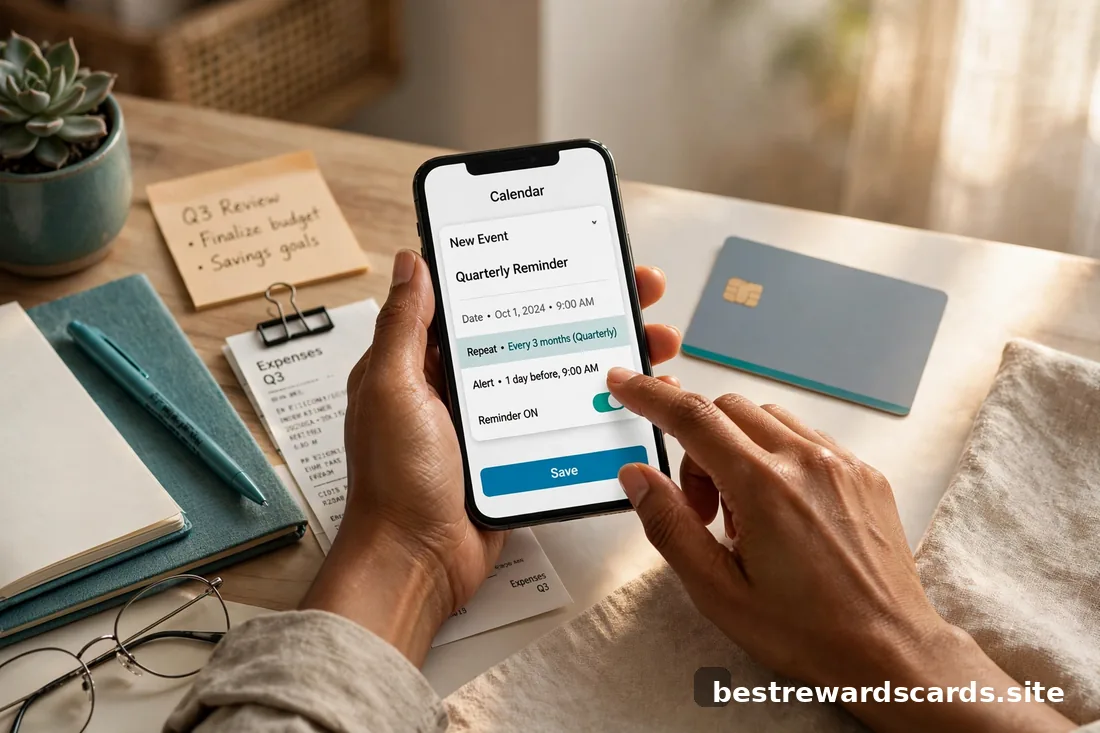
- Set a recurring calendar reminder for the first week of January, April, July, and October: “Activate rotating categories.” Two minutes, four times a year.
- Pair it with a flat 2% card. The rotating card handles bonused categories; the 2% card handles everything else. Never let the rotating card be your only card — its 1% base rate is a trap.
- Check the cap. If a quarter bonuses groceries and you’re a big grocery spender, know when you cross $1,500 and switch to the 2% card for the rest of the quarter.
- Don’t manufacture spending. Shifting real spending is smart; inventing spending is expensive.
Key takeaways
- An optimizer earns ~$660/year from a rotating 5% + flat 2% combo vs $480 from flat 2% alone — a $180 edge for about 80 minutes of annual effort.
- A forgetful user earns ~$240 on the rotating card alone — $240 behind the simple choice. Diligence, not the card, determines the outcome.
- The Chase Freedom Flex is the safer rotating card: 3% dining/drugstores and 5% Chase Travel mean even unactivated quarters earn well.
- Discover it’s first-year Cashback Match is the best no-fee intro in the market — effectively 10% in bonused categories during year one.
- Never let a rotating card be your only card; pair it with a flat 2% card so unbonused spending still earns well.
Frequently asked questions
Do I have to activate rotating categories every quarter?
Yes. Both the Discover it and Chase Freedom Flex require quarterly activation — usually a tap in the app or a click from an email. Unactivated quarters earn 1% even in the bonused categories. Set a recurring reminder for the first week of each quarter.
What happens if I spend more than $1,500 in a bonus category?
Spending beyond the $1,500 quarterly cap earns the base 1% rate. If you regularly exceed the cap in a bonused category, switch to your flat 2% card (or a dedicated category card) once you cross it.
Is the Discover it or Freedom Flex better for rotating categories?
The 5% mechanics are nearly identical. The Freedom Flex has a much stronger baseline (3% dining, 3% drugstores, 5% Chase Travel), so it’s better if you might miss activations. The Discover it has the first-year Cashback Match, so it’s better in year one. Many optimizers eventually carry both.
Can rotating categories ever beat a 2% flat-rate card on their own?
As your only card, no — the 1% base rate on unbonused spending drags the average below 2% for most people. As part of a two-card setup with a flat 2% card handling everything else, yes, comfortably.
Are rotating category cards good for building credit?
They’re fine — no better or worse than any other card for credit building. Payment history and utilization drive your score, not your rewards structure. Pick the card for its rewards fit, and build credit by paying on time and keeping balances low.
Reward Radar is an independent comparison site. This article is for general educational purposes only and is not financial advice. Quarterly categories, caps, and card terms change — verify current terms with the issuer before applying. Links to issuer sites are citations, not endorsements.